The material behind the technologies that can't fail.
Single crystal material is rare, hard to make and everywhere that performance matters. Here's where it works, and why.
New to it? A single crystal is one unbroken pattern of atoms from edge to edge. See what that means.
Twelve places it does the work
AI chips and computingWhyNearly every processor, memory chip and AI accelerator is built on a wafer sliced from a silicon single crystal.
Circuits are patterned at the scale of a few atoms, so a single misplaced seam can break them. Chipmaking depends on crystal that is perfect over two meters of length.
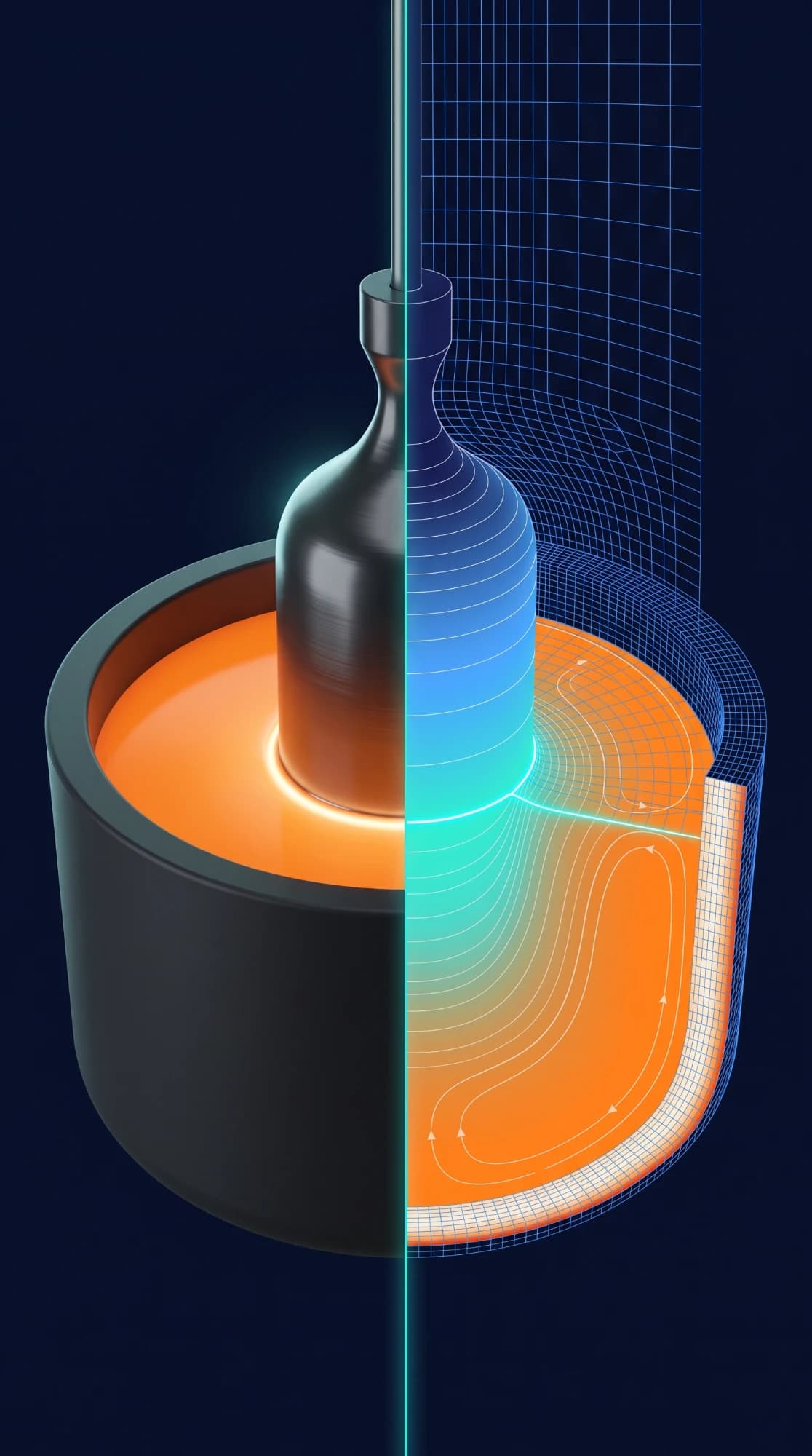
SiliconCzochralski · Melt-grown: our focus
AI data centers and optical networksWhyAI clusters move data as light. The lasers that make that light are built on indium phosphide single crystal, and demand now outruns supply.
Silicon can guide light but cannot generate it efficiently, so every optical link, including co-packaged optics, still needs an indium phosphide laser. Laser makers are shipping well below what AI customers are asking for.
Indium phosphide, gallium arsenideVGF and Bridgman · Melt-grown: our focus
Power electronics and electric vehiclesWhyThe chips that move power in electric cars, fast chargers and data center power supplies waste less energy on wide-bandgap single crystal.
Silicon carbide leads today. Gallium oxide, which can be grown from a melt like silicon, is an emerging option that could make these substrates cheaper.
Silicon carbide, gallium oxideVapor transport; gallium oxide from melt
Wireless and RFWhyEvery smartphone carries many tiny filters cut from single crystal that pick its signal out of the air.
Lithium tantalate and lithium niobate turn radio signals into sound waves on the chip surface to filter them, and gallium arsenide powers the amplifiers.
Lithium tantalate, lithium niobate, gallium arsenideCzochralski and VGF · Melt-grown: our focus
Lighting and displaysWhyMost blue and white LEDs are built on sapphire wafers, sliced from crystals that can weigh hundreds of kilograms.
Sapphire is hard, clear and stable, which makes it an ideal base for growing light-emitting layers. The largest sapphire crystals have passed 300 kilograms.
SapphireKyropoulos · Melt-grown: our focus
Infrared and defense sensingWhyThermal cameras that see in the dark are built on detectors grown on cadmium zinc telluride single crystal.
Infrared detector layers must match the crystal beneath them atom for atom. These systems serve defense, satellites, firefighting and industrial inspection, and germanium single crystal forms many of their lenses.
Cadmium zinc telluride, germaniumBridgman, VGF and Czochralski · Melt-grown: our focus
Medical imagingWhyPET scanners find cancer by catching faint flashes of light inside thousands of small scintillator crystals.
Faster, brighter crystals such as LSO let scanners time each flash precisely, which means sharper images, shorter scans and lower doses.
LSO and LYSO, BGOCzochralski · Melt-grown: our focus
Radiation detection and securityWhyCargo scanners, nuclear safeguards and handheld radiation detectors use single crystal that turns invisible radiation into a clear signal.
Cadmium zinc telluride detects X-rays and gamma rays at room temperature, so detectors can be small enough to carry.
Cadmium zinc tellurideBridgman and VGF · Melt-grown: our focus
Jet engines and power turbinesWhyThe hottest blades in a jet engine are cast as one single crystal of metal.
With no grain boundaries to slowly creep apart, these nickel superalloy blades work in gas hotter than their own melting point, with the help of internal cooling. Larger blades for power-plant turbines are the next frontier, because big single crystal parts are much harder to make.
Nickel superalloysDirectional solidification casting · Melt-grown: our focus
Solar power on Earth and in orbitWhyNearly every solar panel made today uses single crystal silicon, and satellites run on cells built on germanium single crystal.
Single crystal silicon converts more sunlight than polycrystalline. In space, multi-junction cells on germanium wafers pass 30% efficiency and resist radiation.
Silicon, germaniumCzochralski · Melt-grown: our focus
Lasers and precision manufacturingWhyThe industrial lasers that cut and weld metal, and many medical lasers, draw their power from a single crystal at the core.
Crystals such as Nd:YAG and titanium-doped sapphire turn energy into intense, controlled beams, from factory cutting to ultra-short research pulses.
Nd:YAG, titanium-doped sapphireCzochralski and Kyropoulos · Melt-grown: our focus
Everyday devices and tough windowsWhyScratch-resistant camera covers, checkout-scanner windows and aircraft windows are slices of sapphire single crystal.
After diamond, sapphire is among the hardest clear materials there is, so it protects optics that cannot be allowed to scratch.
SapphireKyropoulos · Melt-grown: our focus
What cheaper, more reliable single crystal material could unlock.
Growing it today is slow, energy-intensive and expensive. Make it predictable, and more becomes possible.
- Power-plant turbines with single crystal blades, not just jet engines.
- Power electronics that waste far less energy, in cars, grids and data centers.
- Enough laser material to keep up with AI's optical networks.
- Longer-lasting batteries: single crystal cathode particles resist the cracking that wears cells out.
- Sharper, more affordable medical imaging.